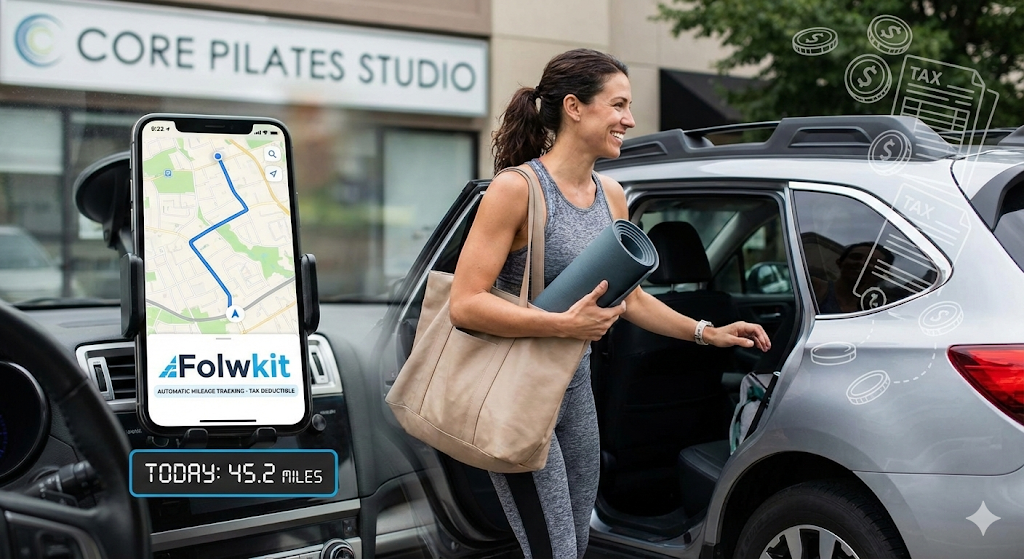
Let’s be real for a second. If you are a mobile yoga teacher, a private Pilates instructor, or an in-home massage therapist, you are not just a wellness professional. You are also a professional driver.
You spend hours in your car zig-zagging across town, sitting in traffic, and finding parking. But here is the thing: Those miles are money.
I recently audited the workflow of a talented mobile massage therapist. She was driving roughly 150 miles a week to see private clients but wasn’t tracking a single mile because she "didn't want to deal with the paperwork."
I did the math for her. At the current standard IRS mileage rate (let's estimate ~69 cents per mile for 2026), she was throwing away nearly $5,000 in tax deductions per year. That is not just "gas money"—that is a vacation, a new certification, or a significant contribution to your retirement fund.
Here is how to stop ignoring your "invisible salary" and start tracking like a pro.
The "Commuting" Trap: What Counts and What Doesn't?
Before you start logging every trip to the grocery store, you need to understand the IRS logic. This is where most LMTs and instructors get flagged.
- Commuting (NOT Deductible): Driving from your home to your first client of the day, or from your last client back home. The IRS views this strictly as "commuting," just like an office worker driving to a cubicle.
- Business Miles (Deductible): Driving from Client A to Client B. Driving from Client B to a studio for a sub class. Driving from the studio to a supply store to buy mats or oils.
Pro Tip: To make your first drive deductible, many instructors designate a "Home Office" (if you qualify) and do administrative work (emails, sequencing) before leaving the house. Consult your CPA to see if this strategy applies to your specific situation.
The Math: Why Guesswork Will Get You Audited
You cannot simply tell the IRS, "I think I drove about 3,000 miles." You need a contemporary log. If you get audited, the IRS wants to see:
- Date
- Destination
- Business Purpose (e.g., "Private Session with Sarah," "Restorative Workshop at Studio X")
- Total Miles
If you try to reconstruct this log on April 14th using Google Maps and panic, you are asking for trouble.
The "Notebook Nightmare" vs. Automation
For years, the standard advice was to keep a small notebook in your glove compartment.
The reality? You forget. You get tired after teaching three back-to-back classes. The notebook gets lost under a pile of yoga blocks. Or, you use a generic mileage tracker app that drains your battery and charges you $10/month just to track drives—adding yet another subscription to your overhead.
This is where the "All-in-One" approach wins. You shouldn't need separate apps for scheduling, client notes, and mileage.
When we designed FlowKit, we realized that for mobile instructors, movement is part of the job.
- How it works: Instead of toggling between apps, FlowKit integrates mileage tracking directly into your client management.
- The Workflow: You finish a session with a client, log their progress notes (for SOAP or sequencing), and tap to log the distance traveled for that session.
- The Result: Come tax season, you export a clean, IRS-ready report that matches your client appointments perfectly. No guesswork, no missing miles, and proof that every mile was attached to a paying client.
Your 3-Step Action Plan for 2026
- Reset Your Odometer: Start the habit today. Even if you missed January, start now.
- Audit Your Route: Are you driving inefficiently? Try to group clients by neighborhood to save time, but remember—shorter drives between clients are still 100% deductible.
- Ditch the Spreadsheet: Unless you love Excel, use a tool that automates this. Whether it's FlowKit or another dedicated tracker, the goal is to make the data entry take less than 10 seconds.
The Bottom Line: You work hard for your hourly rate. Don't let your travel expenses eat into your profit margins simply because you didn't write them down.